

On this page
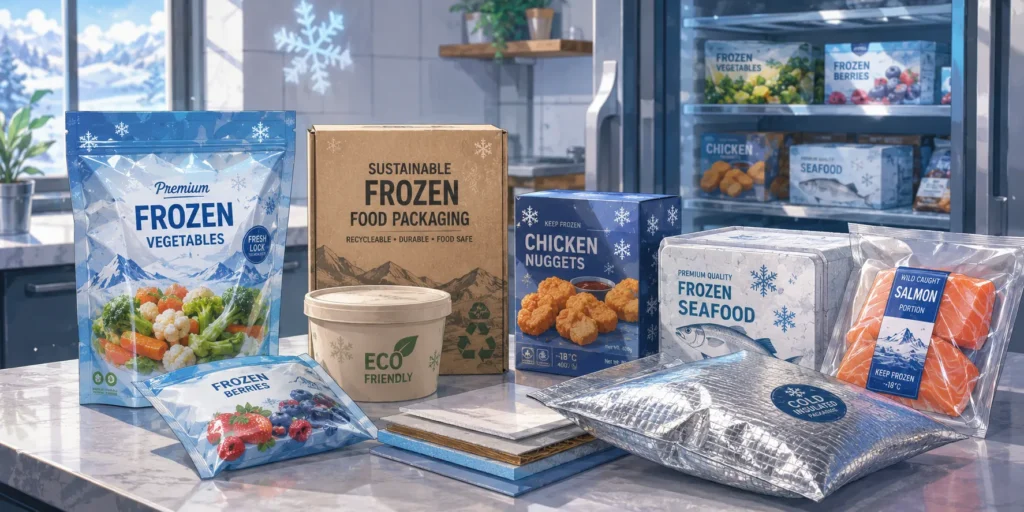
Ever wondered, why do some frozen products stay fresh for months while some end up with freezer burns or excessive ice crystals on them? These freezer burns or food spoilage is not a recipe failure. It’s a packaging failure that starts from choosing the wrong material. Actually frozen food boxes are made from heavy-duty paperboard that is laminated with plastic films and wax coatings. But not all laminated paperboard or plastic can withstand freezing temperatures. So, if you want longer shelf life and zero ice crystal, then start with the right packaging material.
For your guide, we will share some of the best frozen food packaging materials that can resist cold-cracking, trap moisture, and lock the oxygen out. So that your products remain fresh in crowded freezers of retail stores.
Top Frozen Food Packaging Materials
Ever thought why do we freeze our food? Here is the science behind it. Well freezing food stops the bacterial growth and extends the shelf life of the product. But, at sub-zero temperatures the products face harsh challenges like freezer burns and flavor degradation. Therefore, it is recommended to use packaging materials that can survive the cold chain. Here are some of the best frozen food storage packaging materials.
Plastic
Plastic is the most economical and highly effective packaging material for frozen foods. This material has great temperature resistance and remains intact even at -40°C. The most exceptional property of plastic is it blocks the moisture out and prevents freezer burns. Also, it’s flexible, you can mold it to manufacture zip-lock bags or rigid containers. However, you have to be cautious while choosing your plastic depending upon your food type. You can pick from the following options.
Low-Density Polyethylene (LDPE): LDPE performs exceptionally in freezers and has the cold flexibility down to -40°C. It is also known for its superior stretch and impact resistance ability. Therefore, you can use it for making frozen vegetable bags, standup fruit pouches, and cling wraps. You can also use it as a heat-sealable inner liner.
Polypropylene (PP): PP plastic has a thermal from -20°C to 120°C. This is the reason it has an excellent performance at low temperatures. However, PP plastic needs copolymer additive for deep freezer toughness, in case the temperature drops below -20°C.You can use PP plastic reusable, rigid containers for freezer and microwave, both.
Polyethylene Terephthalate (PET): PET plastic has an outstanding tensile strength. You can use it to manufacture standup pouches. Another property of PET plastic is, it offers high clarity and a superior printable surface. Bags made from it allow consumers to check the food quality and quantity. You can use PET plastic to make transparent trays, clear lids, and windowed specialty bags.
Aluminum Foil
Among all the frozen food packaging materials, aluminum foil is the most cost-effective option. You can use it for frozen food items that degrade quickly when exposed to light and oxygen. Because aluminum foil can totally block UV light, moisture, and oxygen. It has an impermeable surface, therefore, it locks in the food’s freshness, aroma, and extends its shelf life.
Using aluminum foil, you can manufacture temperature-resistant packaging containers. Like stamped foil trays for takeaways, baking, and ready meals. It is also used as a laminate for resealable stand-up pouches. By blocking the moisture and air it provides maximum protection and preserves the fats inside the meat and milky ice-creams. For optimal freezer storage, you can wrap meats, hams, and poultry directly in heavy-duty aluminum foil sheets, too.
Wax Coated Cardboard
While plastic and aluminum foil are used to make bags, pouches, trays, and primary packaging containers. Paperboards are used to make boxes that serve as a secondary packaging. Not only they offer high-end durability that support multi-tier stacking. But they have a smooth surface that supports high-impact retail branding. However, paperboards require special lamination to survive harsh freezer temperatures. Types of paperboards used for making frozen food boxes are:
Solid Bleached Sulfate (SBS): SBS paperboard is made from virgin fibers that’s why it does not absorb water. This is the reason boxes made from it do not warp or tear in a cold freezer and maintain their shape. It has a good vertical compression strength, too. Food boxes made from SBS are food-safe and 100% recyclable.
Clay-Coated Recycled Board (CCRB): CCRB paperboard is used to manufacture sustainable food packaging boxes. Because this material is made from recycled fibers. It is cost-effective but at the same time has weak resistance for moisture. Therefore, CCBR food boxes feature poly-wax or PE coatings that prevent the seeping of grease and moisture.
Corrugated Cardboard: Corrugated cardboard is the best packaging material for shipping frozen foods long distances. It is highly rigid and insulates very well. It even prevents crushing during freezing, warehouse palletizing, and retail freezer stocking.
Any type of wax-coated cardboard box is suitable for frozen pizzas, meats, and baked goods.
Here is a quick review of different materials and their possible uses.
Food Type | Recommended Material | Primary Benefit |
Vegetables & Fruits | LDPE Pouches | Economical, High moisture barrier |
Bone-in Meats & Seafood | PET Bags or PET Laminated Pouches | Extreme Puncture Resistance |
Ready-to-Eat Dinners | Aluminum Foil Containers | Dual ovenable convenience |
High-Fat / Sauced Meals | Aluminum Foil Containers | Oxygen barrier to prevent oxidation. |
Key Features That Enhance Freshness and Convenience
The threat to freezer burns and food spoilage doesn’t end with picking the right frozen food packaging materials. Therefore, you need to integrate some functional features so that the packaging can hold up to all sorts of freezer threats. These features are:
Resealable Zippers: Resealable zippers are heavy-duty, airtight closures. Their purpose is to stop the sub-zero freezer air from entering inside the plastic bag or pouch. As a result the food remains fresh for weeks and even months.
Tear Notches: Sometimes to lock the air and moisture out, brands end up making hard-to-open packaging. Therefore, consumers are compelled to use knives or scissors to open the box. This poses a serious threat to the food inside and compromises its quality. To resolve this issue, you can design your packaging with tear notches. They offer a seamless opening experience. And the products remain safe.
Buy Premium-Quality Frozen Food Boxes From Us!
Whether you are packing raw meats, ready-to-eat meals, or baked goods, you need durable, sturdy boxes. Boxit Packages offers the best packaging containers for frozen foods. From LDPE plastics to wax-coated paperboards, we offer a wide range of frozen food packaging materials. Our every container is tested at sub-zero temperature of -40°C. You can request samples for quality assurance. Contact us today to get commercial-grade freezer-safe boxes and bags.
Need custom printed boxes?
Contact us
.jpg)