On this page
Customizing business cards, flyers, postcards, or retail boxes? Do not pick the paper weight unless you know what GSM actually is. The word “GSM” might feel like a foreign language but it’s a technical term used to measure the paper weight. It basically stands for “Grams per Square Meter”, and tells how sturdy the paper is. Thus based on the GSM there are a variety of papers to work with and choosing the wrong paper weight can make your business cards, flyers, and even custom boxes look cheap.
So, let’s demystify paper weights once and for all in this guide by discussing what GSM is? How it works and what is the right paper weight for your project? Let’s get started!
What Does GSM Actually Mean?
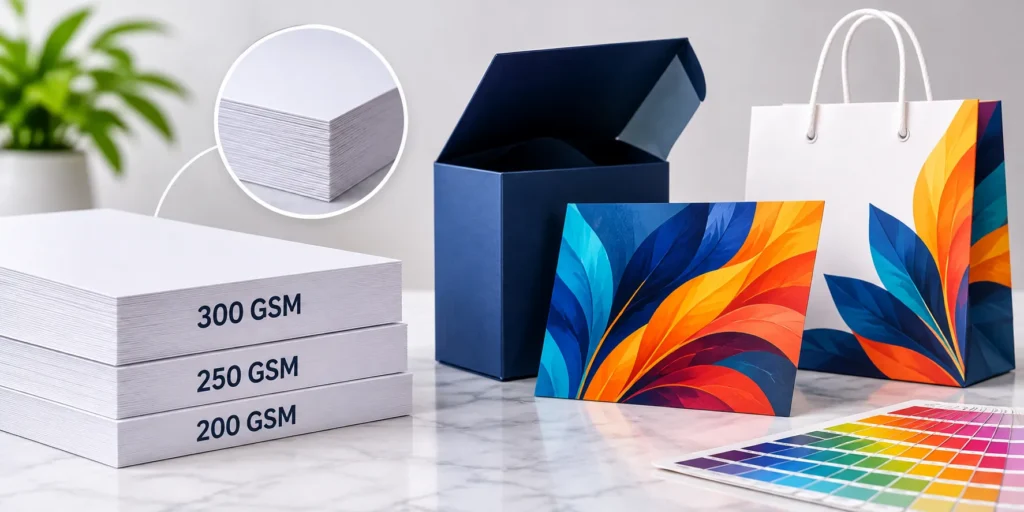
GSM is a universal unit used by printing and packaging industries for measuring paper weight. The acronym stands for grams per square meter. To put it simply it measures the weight of a single sheet of paper cut to a 1m x 1m square. For example if the 1m x 1m paper sheet weighs 80 grams then the paper weight will be 80 GSM. Similarly, if the sheet weighs 300 grams, it is 30o GSM then.
To know the paper weight here is a thumb rule. The higher the GSM number is, the thicker the paper will be. Whereas a low GSM means the paper will be lightweight, flexible, and semi-translucent.
Does High GSM Always Mean Thicker Paper?
There is a common misconception that GSM and paper thickness are the same thing. Actually, they are not. GSM measures mass whereas thickness measures the distance between the surface of a single sheet of paper. This means two different types of paper sheets can have the same GSM but they can vary in thickness. One can be a little bulkier compared to the other.
Ever wondered, why two sheets have the same GSM but different thickness? Well, the variance comes down to three factors. First is the fiber density which means papers that are pressed tightly have high fiber density and are thicker. While loosely pressed sheets are thinner. Second is the pulp type. Papers made from natural wood pulp are bulkier whereas sheets made from chemically processed wood pulp are thinner. And the last factor is the paper finish. An uncoated paper has a porous structure that’s why it is thick. While the coated sheets have the filled fiber gaps, making them feel thinner per GSM.
Why Choosing the Right GSM Matters for Printing
Can you guess why the right paper weight matters and how does GSM affect printing? You will be surprised to know that picking the wrong paper type can ruin your brand image and waste money. Here is an example, if you print on a paper which is too thin, the ink bleeds and the paper looks wavy, warped, wrinkled, or rippled. And if you use too thick paper then your printer can jam.
Another important factor is how paper GSM affects printing quality. Heavier paper absorbs ink differently, resulting in sharper images and more vibrant colors. This makes higher GSM paper ideal for high-quality printing projects. Therefore, it is important to choose the right weight of paper for printing.
The Importance of Paper Weight (GSM) in Packaging
In printing business cards, post cards, magazines, or flyers, the selection of a right paper GSM is more of an aesthetical choice. But in packaging it is a structural necessity. When you are manufacturing custom boxes, sleeves, or shipping containers, your paperboard is the primary line of defense. Boxes made from higher GSM cardstocks create a robust packaging that protects the product from damage during display, storage, and transit.
Also, packaging customized from high GSM boards support tactile surface finishes like embossing or hot foil stamping without warping. This communicates the premium value and quality of the product and allows business to set a high price tag.
The Ultimate Paper GSM Ranges & Their Uses
Printing greeting cards for the holiday and not sure whether 150 GSM will work the best or 300 GSM? Don’t worry. Here is the complete GSM reference guide that can help you pick the right paper based on your durability requirements and budget. Find your project below to lock in the right GSM you need.
GSM Range | Paper Flexibility | Key Characteristics | Common Uses |
35 – 55 GSM | Ultra-thin, delicate, highly flexible | Translucent, low cost, minimal handling strength | Newsprint, receipts, tracing paper |
70 – 90 GSM | Standard lightweight, flexible | Smooth feed in home printers, susceptible to show-through with heavy ink. | Everyday copy paper, notebook pages |
100 – 120 GSM | Mid-weight, crisp, semi rigid | Professional tactile feel. Zero ink show-through for double-sided text documents. | Premium letterheads, corporate stationery, high-end copy paper, envelopes |
130 – 170 GSM | Medium cardstock feel, sturdy | Ideal for vibrant full-color printing. Holds folds cleanly without cracking. | Posters, event flyers, tri-fold brochures, magazine inner pages |
200 – 250 GSM | Lightweight board, semi-rigid | Premium feel that retains shape when held upright. | Magazine covers, booklet covers, thick promotional flyers |
300 – 350 GSM | Heavy weight cardstock, rigid | Durable, thick stock that withstands postal transit and heavy handling. Requires scoring before folding. | Business cards, greeting cards, postcards, retail product cartons |
400+ GSM | Extra heavy, rigid board | High-end luxury appeal. Maximum structural strength. | Luxury business cards, wedding invitations, rigid packaging boxes, hang tags |
Bookmark this chart for your next project so that you don’t have to worry about how to choose paper GSM.
Common Mistakes to Avoid When Choosing Paper GSM
By chance or mistake, if you end up picking the wrong paper GSM, then your post card, magazine, or flyer will not only look bad and cheap. But it’s a total money pit. Therefore, be specific about your project needs while picking your paper GSM and avoid the following pitfalls.
- If your project requires a stock over 170 – 200 GSM, mechanically score the paper before folding. Otherwise the dried ink will snap the fold line and create jagged white cracks.
- Don’t print paper above 220 GSM in home or office printers, they are designed for lightweight 70 – 120 GSM stock. Feeding a high-grade paper can result in paper jam, roller slippage or unfused smudged toner.
- Don’t invest in heavy cardstock as they match your requirements. This could be a premium investment that can burn your marketing budget with zero return. Therefore, for single-use events choose 130 – 150 GSM paper for cost-efficiency.
Conclusion
Knowing what GSM means and what are its different ranges is important when printing a project and customizing product packaging boxes. Because only then you can make the right decision and balance aesthetics, durability, and cost for your project.
However, if you are still unsure which paper stock is the right fit for your need, contact Boxit Packages. Our specialists will guide you accordingly and provide you with free samples to understand every detail.
Need custom printed boxes?
Contact us