

On this page
Opening a package shouldn’t come with a side of environmental guilt. However, sometimes things are different. As e-commerce grows, so does the mountain of packaging waste in our environment. As a result, piles of Styrofoam peanuts end up in landfills. That’s because most recycling programs find it is not worth the investment to process Styrofoam peanuts. Fortunately, a growing number of businesses are adopting sustainable alternatives to toxic foam packaging. They use starch-based biodegradable packing peanuts. These peanuts look like Styrofoam and feel like Cheetos. However, these peanuts are a unique class unto themselves. But did you know that putting these “green” peanuts in a blue recycling bin can actually do more harm than good. This is because if you recycle them improperly, they may contaminate the plastic streams. Therefore, the best approach is to dispose of them.
If you are eco-conscious then this blog is for you. Read it to explore how to dispose of biodegradable packing peanuts responsibly.
Everything you need to know about biodegradable packing peanuts
Stop! Before you toss packing peanuts in the recycling bin. There are two things you must check. First look whether they are biodegradable or edible packaging. Second, take a test to verify if these foam pieces are actually green packing peanuts. Let’s see how to do this but before that understand the difference between the traditional and eco-friendly one.
Traditional packing peanuts
Traditional packing peanuts are made from petroleum-based plastics. Most commonly expanded polystyrene (EPS) is used. They come in three different shapes. The “S”, the “Figure 8”, and the “W”. These peanuts are lightweight but the real problem is that they can take 500 years to a million years to decompose. Moreover, you cannot recycle them, too. It’s because they are lightweight, so they can get caught in the machinery. You can find these traditional peanuts in three colors. White, green, and pink. This color coding is based on the type of plastic used in manufacturing.
Biodegradable packing peanuts
Green packing peanuts are non-toxic and safe for the environment. This is because they do not contain any plastic content. They are purely made from plant-based starch. Such as Sorghum, Cornstarch, and Potato or Wheat starch. Do you know that these green peanuts are edible? However, the biodegradable packing peanuts edible nature is not meant for human consumption. As they are often exposed to contaminants during shipping, which makes packing peanuts poisonous. So, it’s better to avoid eating them. The only con of these peanuts is they are bulky and can lose their shape if they get damp.
A quick guide to identifying packing peanuts
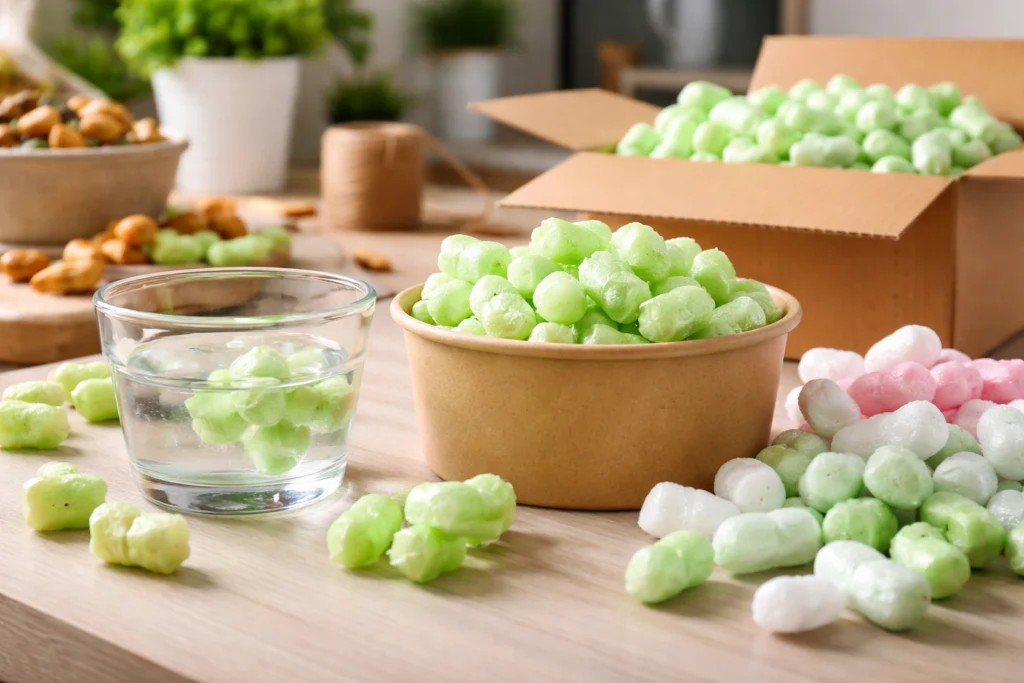
Do you know that traditional and green packing peanuts look exactly the same? Therefore, it is hard to tell just by looking at them. To differentiate between the both, you can conduct two types of tests. One is known as the “‘Lick” test and the other is the “Sink” test.
- Lick Test: It is also called the “Dip” test. This test is simple. Just damp your finger and stick it to the peanut. If it starts to melt or become sticky, it’s a biodegradable one.
- Sink Test: Take a glass of water and drop your packing peanuts in it. If the peanut shrinks or dissolves within a few seconds then it’s starch-based. However, if it floats, it’s a plastic peanut.
Why biodegradable cornstarch peanuts are better for the planet
We-re finally in an era where product protection does not come with a worry of 500-year commitment to a landfill. All thanks to starch-based packing peanuts.
Some other benefits which make them safe for the planet are:
Environmental benefits
- These peanuts are made from renewable crops such as corn starch or sorghum. This means we are saving our natural resources instead of depleting them.
- Their manufacturing process requires less energy and produces 70% less greenhouse gases. Thus, contributing to lower carbon footprint.
- These foam peanuts are recyclable and can dissolve in water in a few minutes.
Practical & safety benefits
- Biodegradable packing peanuts have a good interlocking capacity. Therefore, they can absorb the shocks of rough transit and long-distance shipping.
- They are purely organic and leave no chemical residue when dissolved in water.
Despite these many benefits, the challenge is how to get rid of packing peanuts safely and responsibly?
How to properly dispose of packing peanuts?
There is a right way and a wrong way to handle shipping waste. The wrong way can clog up our local recycling centers. But the right way can save a lot of money on recycling programs. So, let’s explore what are the different solutions for disposing of packing peanuts responsibly.
Composting
Starch-based packing peanuts make a good compost. To make compost, you need nitrogen-rich “green” materials like food scraps and carbon-rich “brown” materials. Packing peanuts can be used as carbon-rich “brown” material. Just mix them in a balanced ratio with green materials in a compost bin. Keep the pile moist, in this way the peanuts will break down faster.
Dissolve in water
If you find composting a laborious work, then we have a more easy solution for you. Take a bucket of water and drop your packing peanuts into it. All the peanuts will dissolve and be gone in no time.
Reusing the biodegradable packing peanuts
If you think you are creative and reuse the peanuts. Then, there is no better alternative than repurposing. You can reuse the peanuts in a plant liner in the bottom to improve drainage. Or you can also use them in a cooler as an insulation to keep the drinks cold. Last but not the least, reuse them to store fragile crockery, decorative ornaments, and glass products.
Donate them
Since green packing peanuts are eco-friendly. This means they are designed for a second life. Just donate them. You can offer peanuts to local businesses or people moving to other places. Everyone wins!
These disposal solutions are perfect for green packing peanuts. However, if you ever come across the traditional ones, then the best option is to:
Keep them clean and ready for reuse.
Reusing the traditional peanuts is effective to reduce plastic from the environment. Do not put them in the recycling bin. As they can contaminate the plastic recycling stream. Or do not litter, because they contain additives that are poisonous and can harm the local wildlife.
Conclusion
Whether you are dissolving your packing peanuts in water or adding them to a compost. Just remember the golden rule: perform the “Lick” or “Sink” test to confirm the starchy nature. After identification choose the method of disposal that suits your lifestyle perfectly.
For all your packing needs, Boxit Packages we have got your back. You can get recyclable foam peanuts and packaging boxes wholesale from us at affordable rates.
Need custom printed boxes?
Contact us
.jpg)