

On this page
Choosing the box style seems a creative task in a packaging process. The focus is on the design that looks unique and can break the retail shelf monotony to make a product pop. But in reality it is more of a functional choice. Because picking a wrong style can lead to product damage, high freight cost, and frustrated customers. That’s why every business in the market rely on tuck end and tuck top boxes, completely secure and hassle-free packaging cartons for every product. Tuck end vs tuck top boxes, does this ring a bell and sound like the same thing?
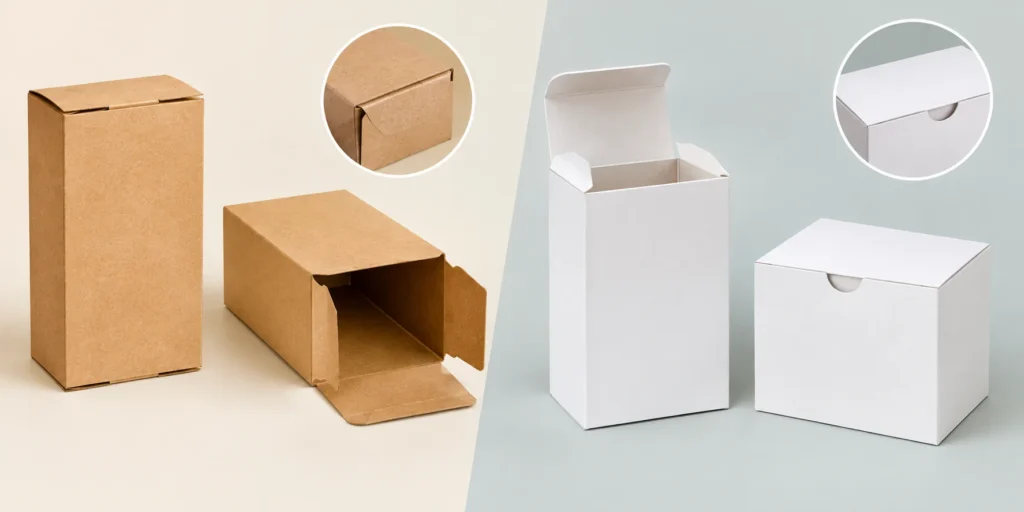
Yes, tuck end and tuck top boxes are the two most popular styles and belong to the same family, folding cartons. But there is one major difference in their structure and therefore, they perform totally different jobs. A tuck end box opens from both the top and bottom sides. While a tuck top box has a jointed bottom and a wide top-opening lid. Now the confusion is how to choose between the two?
In this blog we will make a comparative analysis of tuck end vs tuck top boxes so you can pick the right tuck box for your product. We will discuss structural differences, load capacity, and cost.
Understanding Tuck End Boxes
Let’s start with the simple, classic tuck end box. It is a vertical style folding carton with closure flaps on both the top and bottom end. You can insert the product from either end and tuck the flaps in. The flaps create a secured seal that eliminates the need for glue or packing tape. Custom tuck end boxes are easy to assemble and offer a broad front and back space for branding.
The Two Main Types of Tuck End Boxes
There are two types of tuck end boxes, straight and reverse. Visually both the styles share the same shape but the difference lies in how their flaps fold. In straight tuck end boxes, both the top and bottom flaps fold in the exact same direction, usually from front-to-back. Whereas in reverse tuck end boxes the flaps fold in opposite directions. The top closure flap folds from front-to-back while the bottom flap folds from back-to-front.
Both the boxes provide high-end durability, a smooth surface branding, and hassle-free unboxing. However in terms of cost, reverse tuck end boxes are the most economical ones. Because their flaps open in opposite directions and dielines can be nested tightly together on paperboard sheets during manufacturing. This creates minimal material waste and lowers your overall printing costs.
Best Uses of Tuck End Boxes
Custom straight tuck end boxes are suitable for packing lightweight small to medium retail products. While reverse tuck end boxes work best for the items that do not put heavy downwards pressure on the base and online products where product safety is mandatory during shipping.
The following products are best suited for tuck end box packaging.
- Cosmetics & Skincare
- Food & Confectionery
- Soap & Toiletries
- Medicinal & Supplement Goods
- Small Electronics & Accessories
Understanding Tuck Top Boxes
While tuck end boxes open from both ends, tuck top boxes have a solid bottom base. They have a wide hinged lid top opening that opens like a chest or display box. Due to the solid base, tuck top boxes provide extra structural strength and can bear the heavy weight of bulky items. Unlike tuck end boxes that are made from lightweight paperboards. Custom tuck top boxes are manufactured from heavy-duty cardstocks like corrugated cardboard to create impact-resistant packaging.
Design Variations in Tuck Top Boxes
The true versatility of tuck top boxes lie in how the base is constructed. And depending upon the base there are two types
- Tuck Top Auto Bottom Boxes: They have a pre-glued base that pops into a rigid structure when the box is flattened out.
- Tuck Top Snap Lock Bottom Boxes: These boxes have four flaps at the bottom that are manually interlocked together to create a reinforced base.
Both styles of tuck top boxes do not require glue or packing tape. And with strong bottom bases, they excel in e-commerce, gift packaging, and heavy retail goods. Like:
- Glassware
- Candle Jars
- Retail & Holiday Gift Sets
- Subscription Boxes
- Shipping Mailers
Key Differences Between Tuck End vs Tuck Top Boxes
Let’s look past the names, anatomy, and uses of tuck boxes and find the real difference between the two.
Structural Strength & Weight Capacity
How much load and pressure a box can take without bending or collapsing depends on its bottom base. Since tuck end boxes have friction-fit flaps at the base, there is a high risk of popping the bottom open if bulky items are added. That’s why these boxes are suitable for lightweight items that weigh around 1 – 2 lbs. On the other hand, tuck top boxes either come with interlocking flaps or glued seams at the base. This increases the load bearing capacity of the packaging by distributing weight evenly, making a safe option for heavyweight and fragile goods.
Unboxing Experience & Presentation
What makes the customer return and boost repeat purchase is the packaging’s enticing presentation and unboxing experience. A joyful unboxing moment implies that the brand invests heavily in its work, raising the perceived value of the product inside.
Tuck end boxes offer a limited unboxing experience because the product is hidden inside the sleeve. Thus, the boxes are more of a functional and product promotional solution. Whereas tuck top boxes open upward like a chest or book lid, providing an immediate, wide-angle presentation. This makes them the gold standard for e-commerce, gift sets, and subscription boxes, allowing for custom inserts, tissue wrapping, and inner-lid promotional printing.
Assembly & Cost
Tuck end boxes require manual tucking at both ends whereas tuck top boxes like auto lock bottom assemble in a single motion. Thus, tuck end boxes take time to pop into shape and have a higher labor cost.
As for manufacturing cost, tuck top boxes lose here. They require larger dieline footprints and thicker corrugated board to support auto-bottom structure. That’s why they have a higher production cost.
| Features | Tuck End Boxes | Tuck Top Boxes |
|---|---|---|
| Opening Mechanism | Top & Bottom Flaps | Top Hinged Lid Only |
| Bottom Strength | Light to Moderate | High Due To Solid Base |
| Assembly Speed | Fast | Very Fast |
| Construction Material | Lightweight Paperboard | Corrugated Paperboard |
| Best For | Shelf Display & Lightweight Items | Shipping Mailers & Heavy Products |
Let’s make a quick review of side-by-side comparison of tuck end vs tuck top boxes for more clear understanding.
How to Choose the Right Box Style for Your Brand
Still stuck between tuck end vs tuck top boxes and confused to make the final call for your product line? Here are some rules that can help you pick the winner for retail brands.
- Choose tuck end packaging for products that are lightweight and weigh under 1 – 2 lbs. Also, if the shelf space is limited and you need visually enticing packaging in high-volume at low cost, then again these boxes are the ideal option.
- If you run an e-commerce brand or provide direct subscription services to consumers then pick tuck top boxes. You can also use tuck top packaging for products like jars, candles, and tech accessories that are bulky and fragile.
Wrapping it Up!
Now that you know the key difference between tuck end vs tuck top boxes, choosing between the two will not be a daunting task. You just have to remember this golden rule. Use tuck end for lightweight, vertical retail items like cosmetics and soaps, and switch to tuck top whenever you need extra bottom strength or a wide, chest-style opening.
You can get these boxes customized in any size for retail display, subscription services, and holiday gift sets. Boxit Packages provide endless design possibilities. We provide market competitive packaging rates with free shipping in the United States. You can contact us through email or call us to discuss your requirements and create a perfect box.
Need custom printed boxes?
Contact us
.jpg)