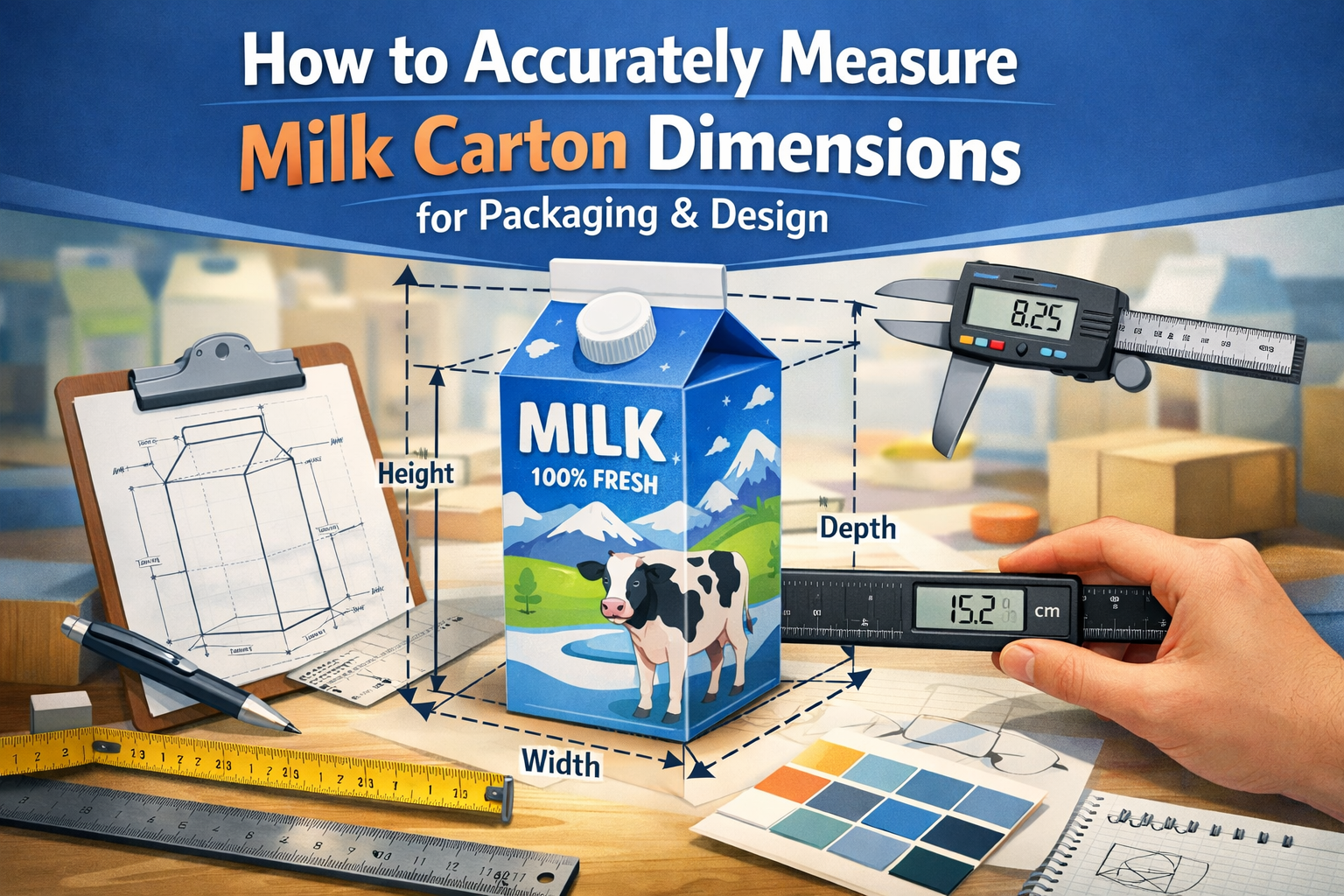
How to Accurately Measure Milk Carton Dimensions for Packaging & Design
Recent Posts
-
 What Makes Vape Packaging Boxes... September 7, 2026
 -
 How to Create Better Product... September 2, 2026
 -
 How Retail Packaging Shapes the... August 31, 2026
Most packaging failures don’t start at the factory. They start on the drafting table with a misplaced measurement. Especially when it comes to milk cartons. Even a slightest difference in millimeters can compromise the product integrity. Thus leading to inaccurate fill levels, product waste, and storage and shipping inefficiency. So, if you are developing a new milk brand. Or redesigning your existing label and packaging of the face on the milk carton. The secret to a leak-proof milk carton lies in the perfect geometry. Therefore, it is important to know the milk carton dimensions for placing an order.
However, if you don’t know how to measure milk carton box dimensions accurately. Then don’t worry. We have got your back. Read this blog to explore what are the standard sizes and what is the right way to measure the milk carton dimensions in an easy way. So, let’s get started!
Why are your milk carton dimensions a big deal?
Before measuring the dimensions of custom packaging boxes. Can you tell what is that one critical element without which you cannot sell perishable goods? It is the product’s safety, quality, and freshness. If your milk becomes sour, spoiled, or curdled while sitting on a retail shelf. The problem is the packaging. Without accurate dimensions, the most advanced pasteurization in the world won’t save your product. Hence, precision is the key to product safety and extended shelf-life. Moreover, if a milk carton is either tall or too small than the required size, then it might result in:
- Product waste and increased production cost.
- Wrong sizes don’t stack well. Thus, wasting warehouse space and transportation costs.
- Inaccurate packaging often leads to milk spilling. This disaster can fade customer’s trust and loyalty for a brand.
- Most importantly, if the missing milk carton dimensions do not comply with FDA regulations. Then you might have to pay heavy fines and penalties.
A complete guide to standard milk carton sizes
There is no single size of a milk carton. When you walk down any dairy aisle of a grocery store. You’ll see a variety of milk cartons. Each box has different dimensions and is designed for a different purpose like dimensions of cereal box cinnamon toast. Here is a list of the most common milk carton sizes. You can customize your packaging according to the face on the milk carton, these sizes as per your milk volume.
Half Pint
The half-pint is also known as the school milk carton. It is a universal size for single serving and has the capacity to hold 8 ounces or 236 ml of milk. The standard dimensions of these boxes are 2.25″ x 2.25″ x 2.75″. They’re specifically designed to meet children’s nutritional needs and promote portion control in institutional settings. That’s why they are served in kid’s lunches and in gyms.
Quartz
In the dairy packaging, a quart of milk carton is known as the “middle child”. It is slightly taller and wider than small milk cartons. But it is more compact than the half-gallon box. These boxes are designed for limited fridge space and specialty milks like oats, almonds, and lactose-free. The standard dimensions of these boxes are 2.75″ x 2.75′ x 7.5″. They can hold up to 32 ounces or 946 ml of milk and can fit perfectly into the narrow doors of home refrigerators.
Half-Gallon
In the US and many parts of Europe, half gallon milk cartons are the most purchased size for household consumption. That’s why it is popular as a “family workhorse”. This milk carton has the capacity to store 64 ounces of or 1.89 liters of milk. Since these boxes have to lift heavy volume. That’s why they have a wider base with a reinforced bottom to prevent leaks. Also, it is impossible to drink 64 ounces of milk in one sitting. For this reason, manufacturers design half gallon milk cartons with HDPE or PET screw caps. These caps are resealable and air-tight seals that keep the milk fresh. The standard dimensions of these boxes are 3.75″ x 3.75″ x 9.5″.
Gallon
The gallon milk carton is the largest standard size and is used by families with more than 6 members. Unlike a half-pint or quart, a gallon carton occupies a lot of space in a refrigerator. This box is designed for 128 ounces or 3.78 liters of milk. Due to the heavy weight of gallon packaging, these cartons are designed with reinforced handles to avoid spill. The standard dimensions of these boxes are 7.5″ x 4.5″ x 8″.
A step-by-step guide on how to measure milk carton dimensions
Before we discuss the right of measuring a milk carton. Let’s take a look at its structure. A milk carton is made from high-grade, food-safe paperboard or cardboard. Usually 18pt to 24pt thickness of cardboard sheet is used for manufacturing a rigid box. The box is then layered with two PE films and an aseptic aluminum foil. These layers block the light, air, and moisture that can compromise the milk’s quality. The top of the carton is designed with a gable roof that acts as a reinforced seal. Overall the shape of the box is rectangular prism. In custom packaging you can deviate from this standard and personalize your packaging into any shape of your choice. Like octagonal, tetra prism, cylindrical or plastic milk containers.
Measuring milk carton dimensions is not that difficult. All you need is few tools:
- A digital caliper for measuring wall thickness.
- A steel ruler to calculate the height and width. You can use a measuring tape, too.
- A set square to check if all the angles of the carton are 90 degrees.
To measure the dimensions follow the following three steps.
- Measure the height from base to top from four corners.
- Measure the length from the front without including flaps.
- Measure the width of the sides from four corners as well.
By following these three steps, you can customize a perfect rectangular shaped milk carton kids. However, if you want to integrate a gable top. Then, you must reserve the volume gable top to avoid confusion. And for cylindrical packaging use this formula V=πr2h.
Conclusion
When you take the time to accurately map out every fold, bleed, and safe zone. You ensure product safety and your brand’s visual story is told exactly as intended. Therefore, before placing any order, check the half pint, quart, half gallon, and gallon milk carton dimensions accurately to avoid any mishap or disaster. And don’t forget to incorporate your logo, brand-specific colors, and nutritional facts & details. This will create your unique brand identity and attract more customers. You can get your milk cartons customized from Boxit Packages to make your brand stand out and grow your business.
.jpg)