What Does D2C Mean? Business Model, Challenges, and Benefits
Recent Posts
-
 Everything You Need to Know... March 12, 2026
 -
 Safe Computer Shipping Guide: Protect... March 11, 2026
 -
 How Playing Cards Are Printed... March 10, 2026
For decades supply chain was a crowded game of ‘telephone’. The manufacturer contacts the wholesaler. The wholesaler coordinates with the distributor. The distributor reaches out to the retailer and finally the consumer buys a product from the retailer. This business-to-consumer channel was quite strenuous and offered limited profitability to the manufacturer. However, the digital revolution changed the rules. Today brands get to keep every cent of the retail markup and own every byte of customer data. Now businesses don’t have to pay to get shelf space at Target or Walmart. They can build their own empires online. Thanks to the direct-to-consumer business model. Brands that work on direct-to-consumer business strategy get to control their branding, customer data, and profit margins.
So, if you are an entrepreneur and looking for opportunities to enter the retail world. Then, this guide is for you. Read this blog to explore what is the D2C business model? What are the upsides and the obstacles you foresee? Let’s get down to business.
How does the direct-to-consumer business model work?
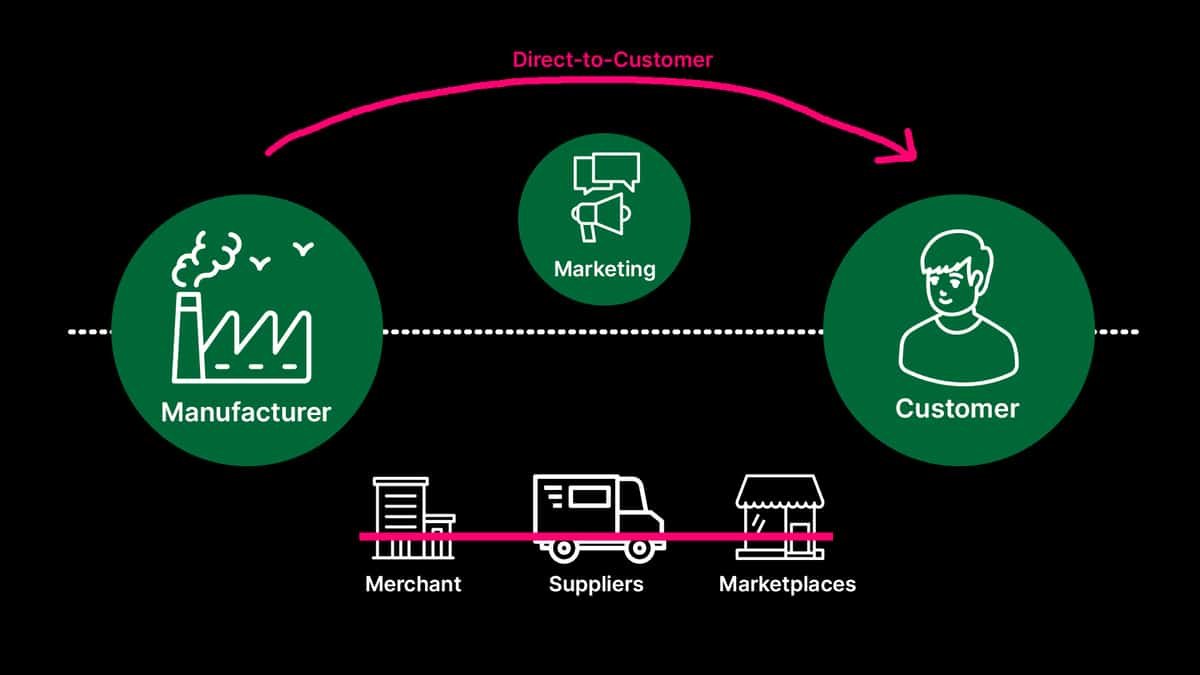
Before we delve into the process of how direct-to-consumer strategy works. Let’s find out the D2C meaning. At its simplest, D2C is a business model where brands sell their products directly to the end customer, bypassing the ‘middlemen’. The wholesalers, distributors, and retailers. This model enables brands to design and dictate the customer experience end-to-end. Moreover, it allows brands broader market reach. Thus, making brands more responsive and independent from traditional retail.
D2C strategy in E-commerce
According to the traditional business-to consumer model the flow is something like this.
Manufacturer → Wholesale → Distributor → Retailer → Consumer
But a successful D2C ecommerce strategy works like a closed-loop ecosystem. Here marketing, sales, and fulfillment all live under one roof to ensure the brand message never gets diluted. In the D2C model, the chain is simplified.
Brand → Consumer
D2C brands are also known as “Digitally Native”. This means they begin selling through digital channels. Like their own e-commerce website or online platform such as eBay or Amazon. These brands manage their own logistics operations. For example, warehousing, packaging, and shipping. However, if the brand is a large enterprise, it can hire a third-party logistics provider that operates under their name.
Since millennials and GenZ prefer buying from online stores. Therefore, the D2C model is booming. In 2025, the US D2C sales projected around $240 billion. And this broader global e-commerce market is projected to reach $6.88 trillion in revenue in 2026. So, starting your business as a D2C brand is a good option.
Top benefits of selling direct-to-consumers
By selling directly, you aren’t just moving products. You are actually building a defensive moat of brand loyalty and personalized experiences that generic marketplace like Amazon or Etsy can never replicate. Some other advantages are:
Higher profitability
In a traditional business, when you sell a product, every middleman (wholesaler, distributor, and retailer) adds its own markup. This means if you sell a product of $20 and the intermediaries claim a 50% of markup on it. Then, you will get $5 as your share. This amount might not cover up your manufacturing cost and your brand ends up in a loss. On the contrary, if you are a D2C brand, you don’t have to deal with the third-party markups. Thus, the revenue is 100% yours.
Stronger customer relationship
By selling products directly to the customers, you get the opportunity to their preferences and purchasing behaviors. Moreover, you can reach out to the audience through social media platforms and e-mail marketing. This mode of communication opens a direct line for customer feedback, reviews, and support. Based on this information you can innovate and personalize the products according to the consumer’s needs. This leads to increased product authenticity, customer satisfaction and life-long brand loyalty.
Complete control over packaging and price
While working with a retailer, you have to adjust according to its requirements. For instance, if the retailers demand for luxury rigid boxes for everyday apparel. Then you are bound to do so. This might cost you expensive packaging and lower profit margins. However, by directly selling to the consumers, you can personalize custom retail boxes wholesale as per the audience preferences. You get the liberty to target eco-conscious customers, elite audiences, and even GenZ. Also through packaging brands can convey their values and story and gain an edge over the competitors.
Same is the case with price. In a B2C model you cannot make last minute adjustments, you have to go through the proper channel, consult with the retailer, and then make changes. Whereas D2C offers flexibility in price adjustments.
The real challenges of D2C model
Cutting out the middlemen does sound profitable. So, why isn’t every brand adopting this model? Actually, in the D2C world, if something goes wrong. There is nowhere to hide. You’ve to do everything by yourself. For instance, if the shipping is delayed or the website crashes. Then, you are the manufacturer, the marketer, and the customer support team all at once. Plus, starting with a clean slate is an arduous process. You’ve to be creative, need effective marketing strategies to enhance brand awareness, and manage online clients at the same time. Some other challenges that D2C brands face are:
High customer acquisition costs
The biggest drawback of direct-to-consumer selling is the lack of retail space that brings shoppers in. In a traditional business, retailers have a reputable market image that helps them in building a strong customer base. This benefits manufacturers too, as they can take leverage of their market standing and convince consumers into buying. Also, in physical stores, customers can check the product quality and features. However, D2C brands have to compete against their e-commerce businesses and need to generate their own traffic through paid digital ads and influencer marketing to get people on their site. These marketing strategies cost brands a fortune.
Logistics and fulfillment
In the B2C model, packaging, shipping and distribution is a responsibility of a wholesaler and retailer. However, in D2C selling you have to manage warehousing, packaging, and shipping on your own. This requires a heavy investment in infrastructure and technology. Such as:
- Order Management System (OMS)
- Warehouse Management System (WMS)
Secondly, today customers expect fast, often free, and reliable delivery with real-time tracking. Fulfilling these consumers’ demands cost-effectively for individuals is a big problem. Especially, when there are large-volume or last-minute orders.
Channel conflict
If you are a brand that sells its product through retail stores and decides to go D2C. In this case, it’s a real head ache. Because canceling the contract may cause a dispute with the retailer and who will be your competitor now. Plus, you may lose your potential customers.
Examples of successful D2C brands
To understand the true potential of selling direct, one only needs to look at the brands that successfully traded the safety of the supermarket aisle for the high-reward world of the digital storefront. Here are a few examples of them.
◊ Glossier
Glossier, a well-known skincare and makeup brand started online through ‘Into the Gloss Blog’. Instead of traditional marketing and ads, the company focused on building a loyal community through social media and customer feedback. Today the company has evolved into an omnichannel retailer.
◊ Casper
One of your home mattresses must be Casper bought. But do you know that Casper started off as a D2C brand. To bypass the retailers, they initially offered one mattress and introduced a “bed-in-a-box” model for hassle-free delivery. What really brought the customers in was their generous 100-day return period. Along with these strategies, they leveraged online ads and social media promotion. Today Casper is one of the partners of Amazon and Target.
◊ Warby Parker
Warby Parker also kicked off as a direct-to-consumer business. They offered their customer a “Home try-one Program”. According to the program, customers can try five glasses frames for free. This boosts the audience’s trust and conversion rate.
Conclusion
D2C model is a commitment to owning the entire customer journey from click to doorstep. Although, there are some challenges with digital competition and logistics management. However, its benefits are far greater. So, if you are ready for your D2C journey, contact Boxit Packages. We can help you in your packaging process.
.jpg)
