The Ultimate Guide to Baseball Card Size and Measurements
Recent Posts
-
 Mushroom Chocolate Packaging Guide for... March 30, 2026
 -
 What Is the Standard Shoe... March 26, 2026
 -
 What Is Glassine Paper? Uses,... March 25, 2026
Baseball cards are the ‘Common Currency’ of American sports. Every baseball card is like a time capsule. It’s an art of a trade, a relic that turns professional athletes into mythical figures, and holds a specific moment in sports history that remains only as long as the card is properly preserved. These cards have evolved from tiny tobacco inserts to thick, diamond-encrusted masterpieces. Therefore, for collectors and investors, a fraction of a millimeter is the difference between a $10,000 payday and a ‘trimmed rejection. This means that the authenticity of the card is known by the baseball card size. Knowing the exact dimensions of a card is your first line of defense against altered fakes.
If you are an enthusiastic collector, then read this blog to save yourself from scam. We have discussed definitive data on baseball card size, thickness, and measurements so you never get scammed at the card show again.
What is the standard baseball card size?
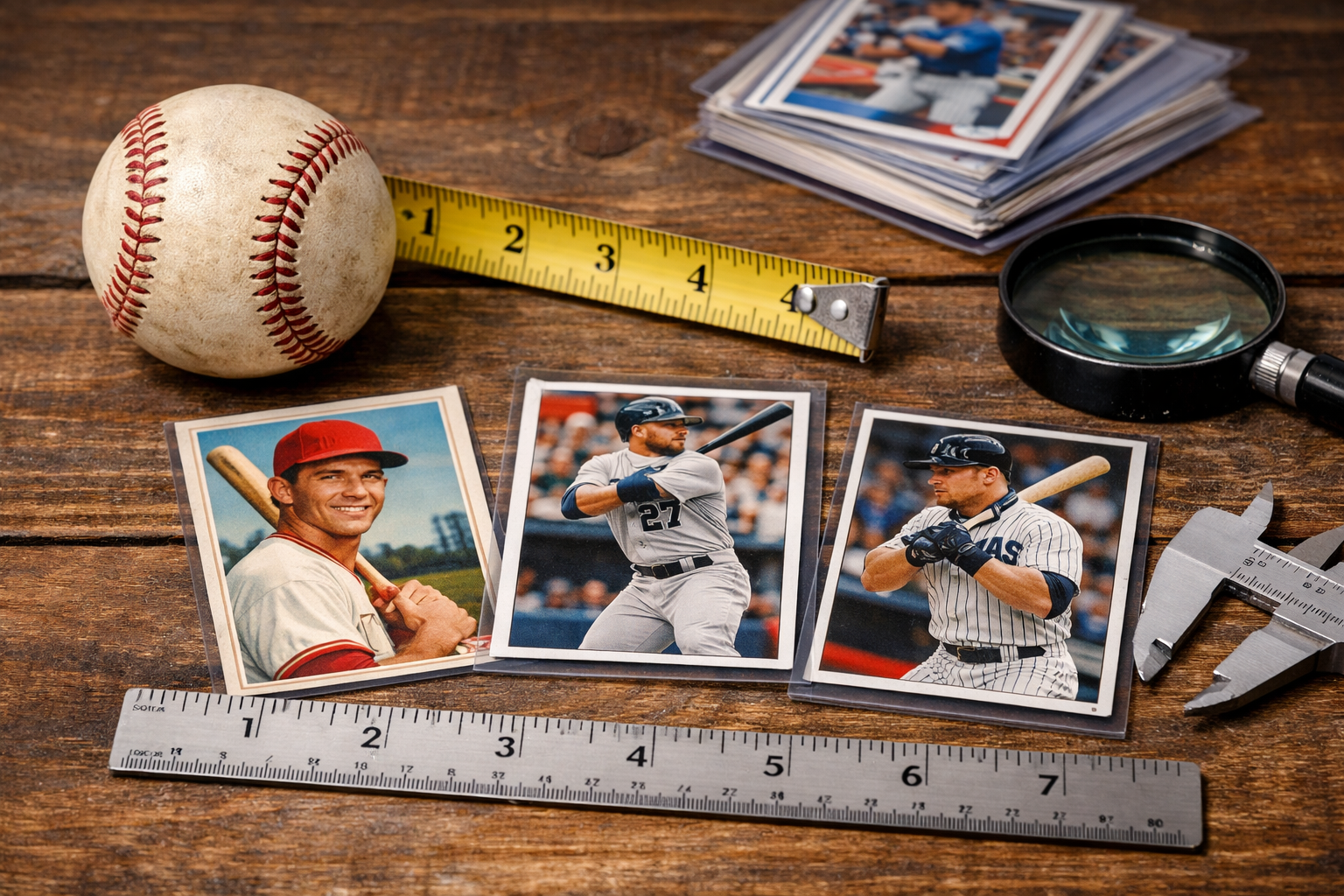
For the first half-century of the hobby, baseball cards were a ‘Wild West’ of dimensions. There was no standard size. The cards were designed to fit into cigarette packs and gum boxes. After 1957, they were designed to fit into the history books. Since then, 2.5″ by 3.5″ is the ‘magic’ number for 90% of baseball cards produced today. This poker size card acts as the perfect, comfortable size for gripping, viewing, and, if used in gaming, shuffling without a struggle. Moreover, these standard baseball card dimensions offer a symmetrical balance between art and text. These cards can accommodate detailed artwork, player photos, and text on the back without appearing too crowded or too empty.
Baseball card measurements from vintage to modern
Understanding the measurements and baseball card size is vital. As a standard modern sleeve will either be far too large or dangerously small for these classics. So let’s begin by exploring how big baseball cards are and how they have evolved from vintage to modern times.
The era began with Tobacco Cards that come in tiny cigarette packs. These cards were known as T206 sets and measures 1-7/16″ x 2-5/8″. Then came the square-ish, compact cards launched by Bowman in the 1940s. This brand was popular for selling collectible baseball cards that measure 2-1/6″ x 2-1/2″. After this, ruled the Oversized Topps cards from 1952 to 1956. These beauties were 2-5/8″ x 3-3/4″. After experimenting with different sizes, the sports industry finally settled for a 2.5″ x 3.5″ format. This size allowed for cost-effective, high-speed printing, and cutting on standard paper sheets. Let’s find out more about these trading card measurements with reference to different units.
Standard baseball card dimensions in centimeters
While the American hobby was built on inches. The global market speaks the language of the metric system. So if you are looking for the metric equivalent of the 2.5″ x 3.5″ standard. Then, the answer is 6.4 cm x 8.9 cm. Consistent cm measurements allow for efficient sorting and display in binders and boxes, maintaining collection uniformity. Although these dimensions are universally used for measuring baseball card size in cm. However, they vary in dimensions from the vintage times. For instance, in the 1930s, Goudey cards were around 6.0 cm x 7.3 cm. Whereas, Willie Mays’ cards launched in 1952 had dimensions of about 9.5 cm x 6.7 cm.
Standard baseball card dimensions in millimeters
Baseball is a global game. But if you are measuring your collection in centimeters, you will quickly realize that precision down to the millimeter is what separates a perfect fit from a damaged edge. Yes, in the world of professional grading, we don’t talk in inches. We talk in millimeters. Therefore, the standard modern baseball card dimensions for 2.5″ x 3.5″ are 63.5 mm x 88.9 mm. For printing and die-cutting, millimeters are used. Because these metric units ensure that cards are cut precisely to the standard size, preventing issues with warped edges or improper dimensions.
Standard baseball card dimensions in pixels
Every sport has shifted to digital platforms. Because digital tools provide better streaming options, direct connection with the audience, and interactive fan experience. Therefore, digital card collection is quite popular these days. So, when it comes to online auctions, inches, centimeters, and millimeters do not work. It’s your card’s pixel count that makes a compelling impression. The perfect pixel baseball card size measures around 750 pixels x 1050 pixels. It is important to note that all the dimensions are measured in width x height.
Understanding card thickness
The baseball card size matters the most in the sports world. But, actually ‘thickness’ is the measurement that catches most collectors off guard. While height and width are usually uniform, the ‘PT’ scale is the secret language of modern card protection. PT stands for points, units of measurement used to determine the thickness of a card and, consequently, the correct size of the protective holder and 1 PT is equal to 0.001 inches. So, if you want to protect your collectibles. It is important to match the card to the correct point size. For premium cards the correct thickness is 55pt. Whereas for standard cards the right thickness is 35pt.
Why 2.5″ x 3.5″ is the golden rule of baseball cards
Standardization isn’t just about order. It’s about safety. When a card matches its housing perfectly, you eliminate the friction, light, and movement that devalue a collection over time. Some other benefits of following the golden rule are:
Optimal storage and protection
The secret to long-term preservation is a ‘snug’ but safe fit. 2.5″ x 3.5″ cards fit perfectly into widely available protective accessories. Like magnetic cases, penny sleeves, and top-loaders. In this way, you can stop the card deterioration due to moisture or dust and maintain their value.
Convenience for trading and selling
Since 2.5″ x 3.5″ are universally recognized standard dimensions for baseball cards. Therefore, trading and selling these cards is easy. You don’t have to worry if the card is fake or whether it fits into standard shipping supplies or not.
Cost-effective manufacturing
Printing images and text on vintage compact or oversized cards was quite tricky which increases the manufacturing cost. The standard size allows for efficient printing and cutting processes. Thus, manufacturers can save a good amount of money.
Conclusion
From oversized vintage cards to standard metric dimensions of baseball card size. We’ve covered every dimension details necessary for global shipping and digital archiving. Now you can shop and trade with confidence. If you still have confusion contact Boxit Packages. We can guide you with the right baseball card size and even customize it as per your brand’s need. Moreover, you can get custom sports packaging boxes from us at affordable rates. They are the best solution to protect your premium items.
.jpg)