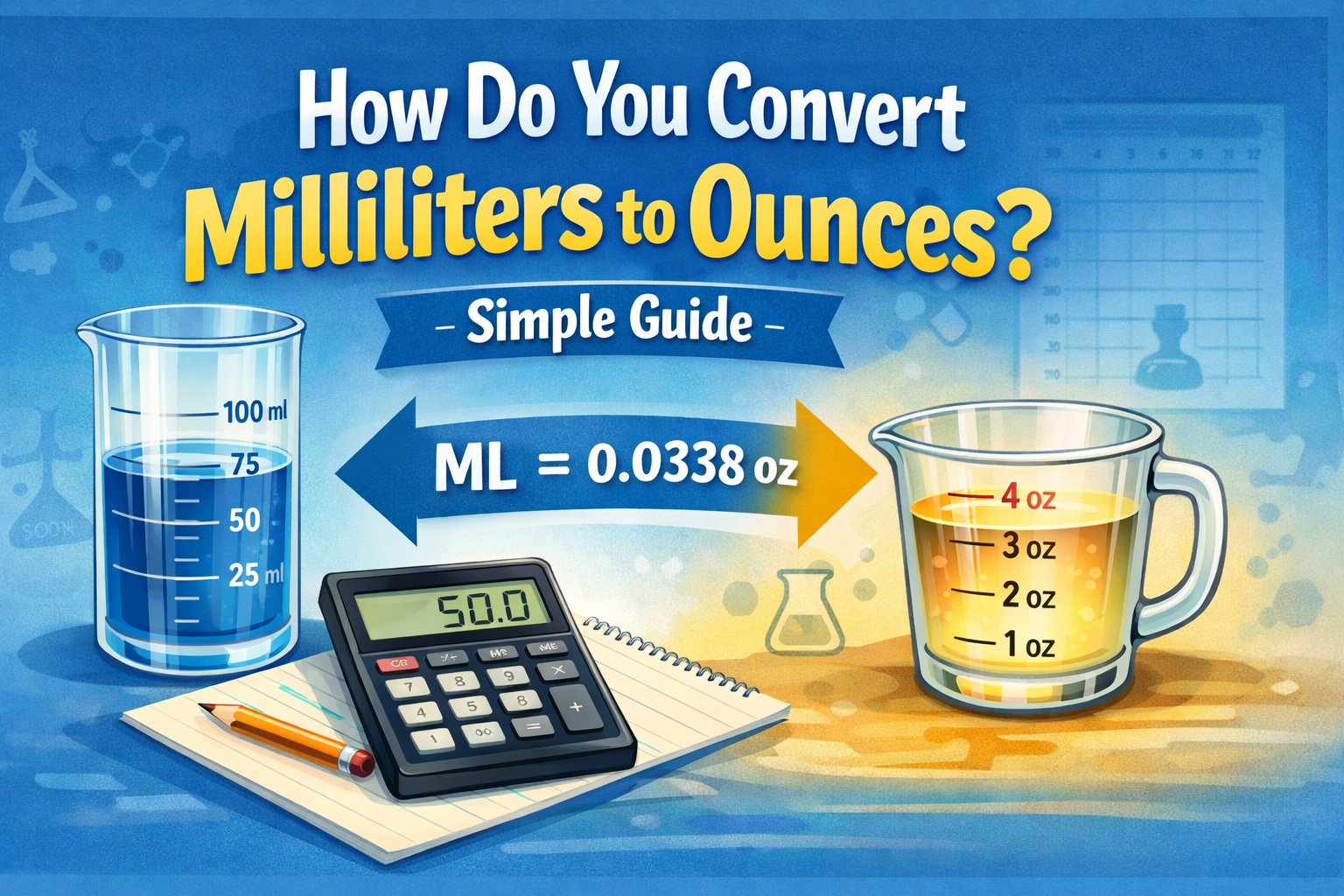
How Do You Convert Milliliters to Ounces? Simple Guide
Recent Posts
-
 What Is Aqueous Coating and... April 6, 2026
 -
 A Helpful Guide to Modern... April 3, 2026
 -
 How to Create a Gift... April 2, 2026
Most people think a fluid ounce is exactly 30 milliliters, but if you’re looking for true accuracy, that ’round number’ might be leading you astray. The official math says that the right answer is 29.57 ml but to get the job done quickly people round it off. This accuracy in measurement is important in various applications such as measuring elements of a cooking recipe or product packaging. Therefore, to convert ml to oz you don’t need a math degree, just follow this guide. We will share the “cheat sheet” formula, a quick reference table, and the one mental math trick that will save you from ruining your packaging or turning your recipe into a disaster.
The magic formula to convert ml to oz
In the USA, primarily US Customary Fluid Ounces units are used. According to which a fluid ounce is a unit of volume, and it is significantly larger than a single milliliter. Specifically, it takes nearly 30 milliliters to fill up just one fluid ounce. However, if you want the precise answer for the conversion then use this formula:
1 Fluid Ounce = 29.5735 ml
Simply divide ml by 29.5735 to get ounces. Conversely, multiply ounces by 29.5735 to find the milliliter equivalent. So with the help of this formula, no matter what the value is, either its 30 ml to oz, 12 oz to ml, 200 ml to oz or 5 oz to ml, you can easily make your conversions.
Ok, here is a quick question for you: how many ml is 4 oz? Use the formula to find the answer and see if you understood the ml to oz conversion.
A common confusion of liquid vs. dry ounces
In the metric system, things are relatively straightforward, but the US imperial system has a bit of a linguistic trap: the difference between volume and weight and that’s where most people get confused. For example if they are trying any recipe that needs to convert ml to oz, they pick a measuring cup instead of a scale. They don’t know that “ounces” can measure two completely different things. One is Fluid Ounces and the other is Dry Ounces. Fluid ounce is the liquid volume which measures how much space a liquid takes up. Whereas the dry ounce is the mass or weight of the ingredient or an object.
Therefore, remember if you are converting from ml, you are always dealing with Fluid Ounces, because both are units of volume.
A quick reference conversion table
Here are some frequently needed conversions between milliliters and fluid ounces:
Milliliters (ml) | Fluid Ounces (fl oz.) | Common context |
5 ml | 0.17 fl oz | 1 Teaspoon |
15 ml | 0.5 fl oz | 1 Tablespoon |
100 ml | 3.4 fl oz | TSA Travel Standard |
240 ml | 8.1 fl oz | 1 Standard Cup |
300 ml | 10.14 fl oz | 1 Small Water Bottle |
350 ml | 11.83 fl oz | 1 Café Style Coffee Mug |
375 ml | 12.68 fl oz | ½ Bottle of wine |
500 ml | 16.91 fl oz | Standard Water Bottle |
750 ml | 25.36 fl oz | 5 Glasses of wine |
With the help of this table you can follow how many oz are in 300 ml, 500 ml, or 750 ml. However, if you think it is hard for you to memorize all these numbers, then for a quick reference, remember that 30 ml is approximately 1 fluid ounce, which can help with rough mental calculations.
Why precision ml to oz conversion matters?
In many scenarios, being “close enough” is fine. But when it involves federal regulations or health, the difference between a few milliliters can lead to a major headache or a health risk. Therefore, from the kitchen counter to the pharmacy cabinet and the retail shelf, precision in measurement is important but can change depending on the application. For instance:
Kitchen cooking recipes
In culinary arts, ml to oz conversion is usually about texture and flavor balance. Although a slight margin of error won’t ruin a soup, gravy, or dessert, it can be the downfall of a delicate pastry. So when a recipe calls for 15 ml of an extract or oil, knowing that this is exactly 0.5 fl oz. This will keep you from over-flavoring the dish.
Similarly if the recipe calls for 120 ml of milk, you would need approximately 4.06 fl oz. knowing that “how many oz is 120 ml” equals about 4 oz can help ensure your recipe turns out as intended.
The cabinet of medicines
When it comes to medicines, you cannot round off your conversion measurements. Because, here precision is a matter of safety and compliance. Actually most liquid medications or syrups are prescribed in milliliters such as 5 ml or 10 ml. The purpose is to avoid the ambiguity of “teaspoons” or “ounces,” which vary by household spoon size. Therefore, by converting ml to oz, you can ensure accurate dosing.
The packaging shelf compliance
In the world of retail and shipping, conversion from ml to oz is about legal standards and consumer transparency. Because in the USA, the law requires “dual labeling” on consumer goods. This means a bottle of oil must show both the metric volume (500 ml) and the US customary volume (16.9 fl oz) to be sold legally in every state. Also when you are designing custom containers especially for beverages and cosmetic items, it is important to calculate the “overflow capacity” in ml to ensure the fluid ounce claim on the front of the box is accurate and allows for heat expansion. So if you want fully compliant custom packaging boxes, get them from Boxit Packages. They are well-aware with all US shipping standards and customize accurate packaging.
Conclusion
Understanding how to convert ml to oz is a fundamental skill for anyone navigating the modern world. For which formulas and measuring cups are excellent for measuring liquids, but if you are looking for 100% accuracy in your recipes or formulations, measuring by weight on a digital scale is the gold standard. It’s the best way to ensure consistency, safety, and professional-grade outcomes in everything you do.
.jpg)