

On this page
The worth of mangos in America is impressive, as they are regarded as an exotic fruit. People not only consume mangoes fresh but also utilize them in various food items. It’s the nutrients, availability and sweetness that attract buyers. Nevertheless, this tropical fruit requires careful management of temperature, gas and many other factors. This is in relation to effective mango packaging and the delivery of their edible condition to the customer’s location.
Conversely, there are aspects other than preventing their damage and waste when it comes to packaging. For instance, PLU codes are for easy scanning. The country of origin should be clearly labeled to meet USDA requirements. Besides, the use of high-quality graphics can trigger the hunger response. After all, they should appear appealing on the grocery store aisle.
The Secrets to Effective Mango Packaging for Minimizing Damage & Waste
There are a multitude of factors involved to safely package different varieties of mangoes. For example, submerging them in water that is famous as hot water treatment. Additionally, another approach is going for the layered defense. It encompasses both primary and secondary packaging. Mangoes are also secured by first testing the stacking strength of the boxes.
The Crucial Role of Hot Water Treatment in Mango Packaging
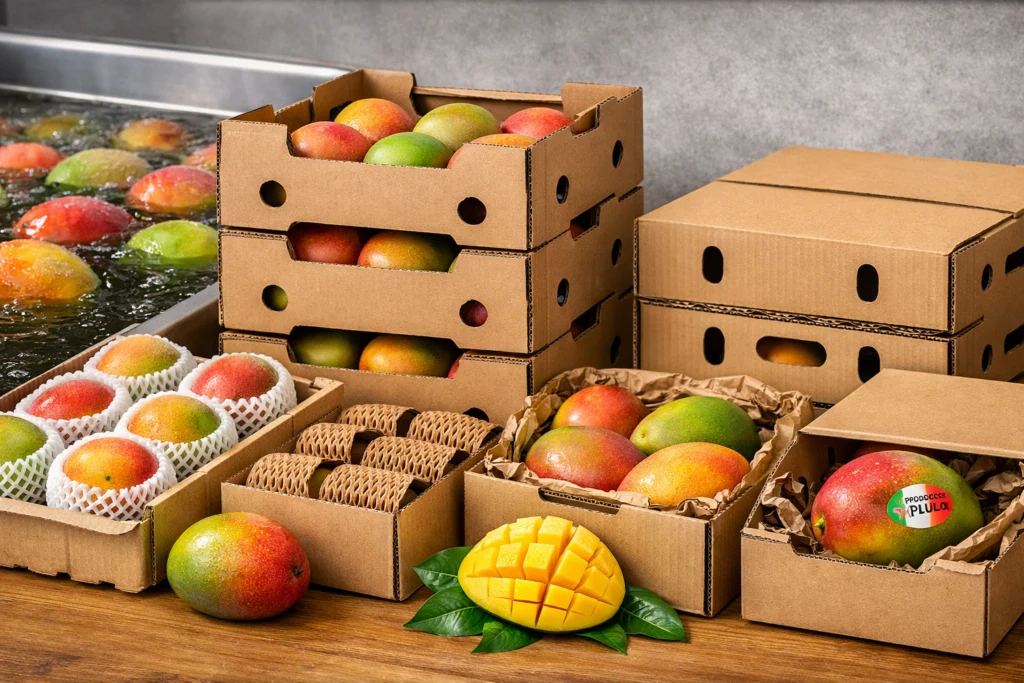
How is mango packaged? Well, it’s a pre-packaging technique first that is highly imperative for their protection. This technique is famous as HWT or hot water treatment, as illustrated above. The temperature for this treatment should be between 46 and 48 degrees Celsius and the apt duration is ninety minutes.
Furthermore, the purpose behind this approach is to eliminate the fungal spores and fly larvae without the use of dangerous chemicals. Nonetheless, there is one prominent disadvantage. The mangoes become highly sensitive to mechanical shock due to the softening of cell walls. Also, the intense heat treatment expands the waxy cuticle.
Primary & Secondary Packaging for Complete Protection
For high-value deliveries, it is not wise to depend only on a single protection layer. Instead, the brands must comprehend two vital sorts for superior product safety. For example, the primary packaging directly interacts with the fruit. The best options in this regard are compostable foam nets and individual honeycomb paper sleeves. Their role is to prevent sap-burn cross contamination.
Moreover, the next layer is the secondary packaging. It is an outer, highly strong corrugated box that handles the external pressure. Thus, the fruit remains firmly in its place with the combination of both these packages. As a result, the companies can relish a reduction in rejection rate. This ultimately helps them to retain customers and grow.
The Rigid Structure Prevents Compression Damage
Compression leads to not only mango damage, but also adversely affecting the profits. Therefore, the effective mango packaging goes through Edge Crush Test. This alternative replaces standard, untested shipping containers that collapse under static load pressure. Stacking is essential during shipment and the boxes at the bottom are under severe pressure. This results in crushing.
Speaking of the Edge Crush Test, its rating illustrates whether or not the boxes will buckle. If you are overlooking this rating, the fruit might face internal breakdown due to compression. While opting for mango packing in boxes, vertical-flute corrugation is the apt pick. This way, the container acts like a structural pillar. So, the structure can withstand many pounds of pressure and still remain intact.
Die-Cut Ventilation Holes to Manage Trapped Ethylene
Mango is a climacteric fruit and this kind keeps on ripening even if it is no longer attached to the plant. On the other hand, ethylene is a gas released by this fruit. When the ripening starts, the fruit begins the aforementioned gas-releasing task. Also, it encourages the surrounding fruits to release their own ethylene. Therefore, the process affects more than one fruit in the package.
Thus, the die-cut ventilation holes come into play. They are strategically placed and align with the forced-air cooling in containers placed in the refrigerators. The circulation of air prevents the fast ripening process. Besides, the ethylene can effortlessly escape. As a result, it enhances the lifespan of these fruits in the containers and makes long-distance delivery convenient.
Cushioning for Safety Against Constant Vibrations
The sender’s goal is to increase or maintain the market value and not the other way around. So, they must be aware of the consistent micro-vibrations. This shaking leads to the rubbing of the fruits against the walls. Ultimately, buyers find these versions unpleasant and may refrain from paying the required amount for purchasing.
To avoid such consequences, there are cushion materials that stop the energy from the delivery vehicles to reach the mango skin. Examples of such materials are expanded paper dunnage and molded pulp trays. Hence, the fruit remains suitable for shelves or sale and there is no fatigue damage that leads to premature rot. A trusted custom packaging supplier like us can definitely help in offering such protection.
Managing Moisture to Prevent the Fungal Growth
What’s the most intricate task of fruit shipping? It is managing the humidity. Mangoes need a certain level of humidity so that they do not lose weight or their form. But the high level of humidity is dangerous for the fruit, as it can form the apt atmosphere for proliferation of black mold.
For this purpose, the packaging should include certain liners and coatings. On the other hand, using a Cobb-tested board can repel liquid water and allow water vapor to move through the vents. This makes sure that the mangoes stay hydrated. Therefore, moisture control can promote your fruits as cleaner and safer products. Boxit Packages can help you out in various ways for completely protected and effective fruit packaging. Just ensure to get a quote or dial our number correctly before placing an order.
Conclusion
Mango packaging is a detailed process with steps to secure the fruits even before putting them into the container. The key goal for such packaging is pleasing and retaining buyers. Also, following all the techniques properly can maintain the market value of these products. Hence, we shared some steps or tips. For example, hot water treatment, two packaging types, rigid structure and ventilation holes. Ensure to contact an expert supplier to guide you through all these steps before shipping.
Need custom printed boxes?
Contact us

.jpg)