

On this page
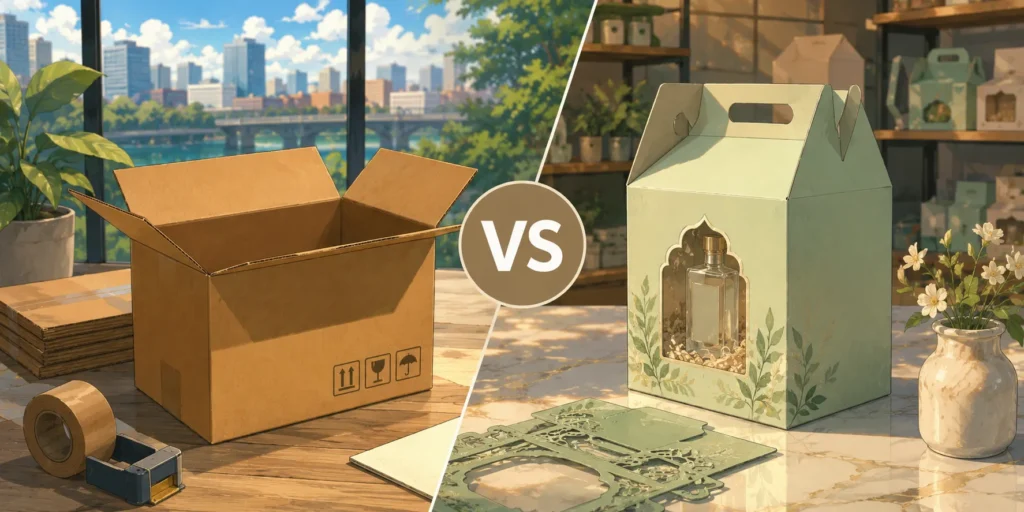
Let’s face it, after spending a fortune on a product, no business wants to spend more money on its packaging. But choosing a unique-styled, durable box is important for the product and brand. A thoughtful box design enhances visual appeal and guarantees safe, flawless delivery. So, when you are looking for packaging, do consider RSC boxes and die-cut boxes. Both boxes are great, offer high-end protection for the products but one fits perfectly on the wallet and other excels in aesthetics. So, which one is the ideal box for your business? Let’s find out by making a comparison between RSC vs. die-cut boxes.
What is an RSC Box?
Have you seen standard cardboard cartons stacked in a warehouse or shipping pallets? Those containers are actually RSC boxes. RSC stands for Regular Slotted Container. The distinctive feature of these boxes is their symmetry. All the top and bottom flaps of RSC boxes are the same in length and meet perfectly right in the center. They are made from a single sheet of corrugated cardboard which is a highly sustainable material. Therefore, RSC boxes are 100% recyclable and you can reuse them, too, for storing your household items.
Pros and Cons of RSC Boxes
To figure out the packaging container suitability for your business, it is better to weigh its benefits against the limitations. Therefore, let’s dive into the pros and cons of RSC boxes.
Pros:
- RSC boxes are manufactured on machines called high-speed slitter-scores. These machines do not cost any tooling or setup charges, that’s why these boxes are cost-effective. So if someone asks which box style is more cost-effective, then the answer is quite clear. It’s an RSC box.
- These boxes are easy to assemble. You just need tape or staples to close the flaps.
- Since the flaps of these boxes meet in the center and equally distribute the weight, therefore, they are incredibly tough. You can stack them or add bulk goods inside them for shipping, the boxes will not collapse.
- RSC boxes are versatile in nature. They meet diverse packaging needs in different industries. Their design and materials suit various products.
Cons:
- RSC boxes are plain brown shipping containers. They lack branding elements and do not have the potential to promote brands.
- Since, the flaps of RSC boxes are sealed using a packaging tape or staples, it can increase the labor and material cost of the packaging.
Application of RSC Boxes in Different Industries
RSC boxes are the gold standard of the shipping world. That’s why they are used for shipping fragile and bulky retail items such as clothing, books, ceramics, and electronics. Due to their high-end stacking strength, you can use RSC cartons in warehouses for storage and optimizing floor space. The boxes are quite popular in the automotive industry, too. Businesses use them to pack heavy-duty spare parts and hardware items that demand safe shipping to customers.
What is a Die-cut Box?
A die-cut box is a tailor-made packaging container cut from a flat sheet of corrugated paperboard using the die-cutting machine. Therefore, these boxes offer limitless customization options. You can design your boxes according to the specific shapes and sizes for your product. Add a window to the packaging to display the product features and even integrate handles and premium closures for a high-end unboxing experience.
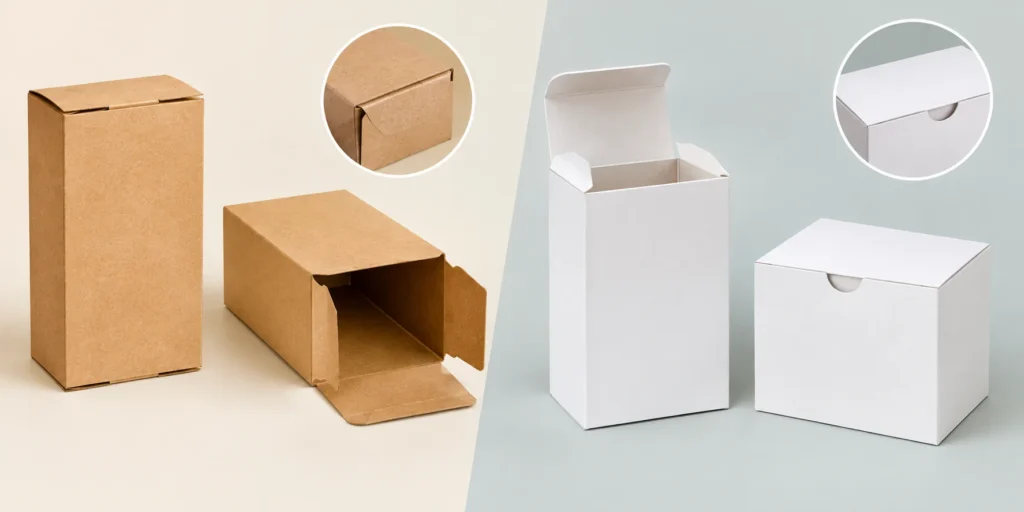
Most die-cut styled boxes feature clever tabs, flaps, and interlocking slots. This means they neatly fold together and lock into place entirely on their own, removing the need for messy exterior packing tape or glue.
In terms of the usage across the different industries, die-cut boxes serve as a primary and secondary packaging solution for e-commerce goods, retail display items, luxury jewelry, cosmetics and skincare products, and high-end electronic gadgets.
Pros and Cons of Die-cut Boxes
Designing a custom shaped packaging offers brands many benefits like elevated presentation, product differentiation, and increased brand visibility. But at the same time these boxes have massive upfront costs. So, to see whether the boxes are a good investment or not, let’s weigh the pros and cons of die-cut boxes.
Pros:
- For shipping, die-cut boxes are the best option. Since every dimension of these boxes matches the exact silhouette of the product. Therefore, they minimize the use of bubble wraps or packing peanuts. This reduces the dimensional weight and lowers the shipping cost.
- These boxes are designed with internal inserts. The inserts hold the luxury items in place and offer maximum protection.
- You get the freedom to customize with die-cut packaging. You can design the boxes with window cutouts and fancy closures like ribbon pulls or magnetic closures. This helps your brand stand out and make the unboxing experience more memorable.
- Since these boxes do not need packing tapes or glue, that’s why they are easy to assemble.
Cons:
- To manufacture a die-cut box, the supplier has to set up a cutting die (the tool) and printing plates. This increases the setup cost and makes die-cut boxes a little costly.
- Ordering a tiny batch of custom die cut shapes can yield a much higher cost-per-box compared to a standard RSC.
Head-to-Head Comparison of RSC vs. Die-Cut Boxes
Still struggling to choose the right box for your product? Here is a quick review of RSC vs. die-cut boxes in the table below. So, if you are not able to make the right decision, the table can guide you.
Features | RSC Boxes | Die-cut Boxes |
Upfront Tooling Cost | Zero custom tooling required | Variable |
Sealing Method | Always requires packing tape, glue or staples | Self-locking Tabs |
Unboxing Aesthetics | Utilitarian Style | Premium, Highly Branded |
Best Protection For | Heavy, Bulky Items and suitable for stacking | Fragile and custom-shaped goods. |
Assembly | Quick & easy | Sometimes tricky, but it depends on the structural design |
How to Choose the Right Box for Your Needs
Choosing between RSC vs. die-cut boxes boil down to balancing your operational limits with your brand goals. That’s why
Pick RSC boxes if:
- You need cost-effective packaging for shipping of heavy and bulky goods.
- Your packaging doesn’t require product-sized dimensions and custom-fitting.
- Your brand focuses on functionality and protection rather than aesthetics.
- You need a recyclable and eco-friendly solution.
Pick Die-Cut Boxes if:
- You want to elevate the visual appeal of the product.
- Your product requires right-sized boxes.
- You need built-in locking features instead of tape or glue.
- You want to increase your brand visibility by creating product differentiation.
Get Customized RSC and Die-Cut Boxes From Boxit Packages!
At Boxit Packages, we specialize diverse packaging solutions, offering high-quality, customized RSC and die-cut boxes according to your packaging needs. We have the expertise in die-cut boxes and provide low MOQ and free design support for them. Let’s create the perfect packaging for your brand together! Visit our website and explore our die-cut box solutions and take your packaging to the next level.
Need custom printed boxes?
Contact us
.jpg)