

On this page
Managing a retail or an e-commerce business is tough work. At every step you are constantly forced to make tough calls out of which the most critical one is the financial dilemma of choosing between a stock packaging and custom boxes. Well, the financial math says stock boxes win by a landslide. They are cost-effective and have lower minimum quantities. However, these cheap boxes aren’t cheap because you end up paying for empty space while shipping. On the contrary custom boxes might have a little high upfront unit cost. But they win the war on long-term profitability. They guarantee product safety and professional branding. So, if you are stuck on the decision to choose between the two, let’s make this easier for you.
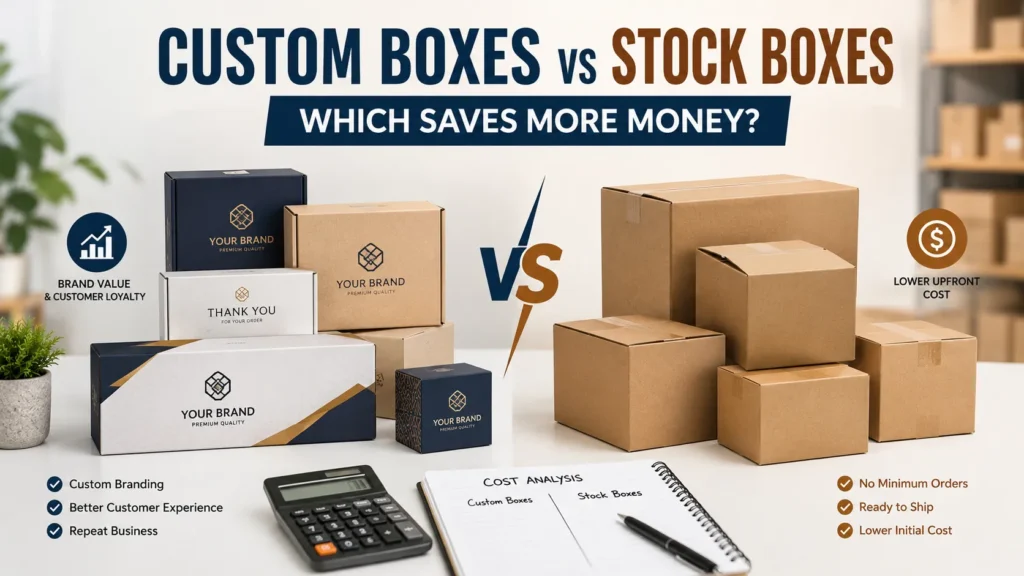
Let’s make a comparative analysis of custom boxes vs stock boxes and discuss the pros, cons, and real costs of both options to choose the best option.
What are Stock Boxes?
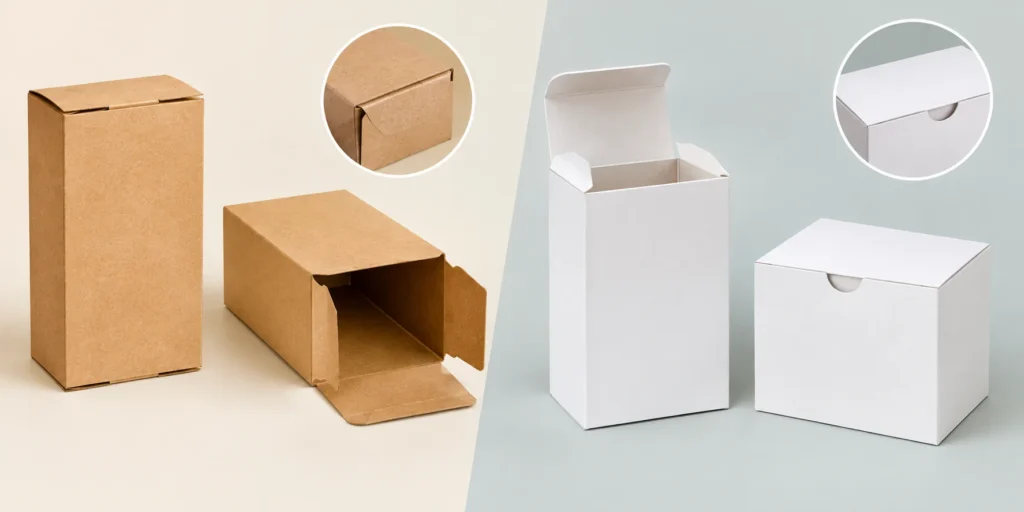
Stock boxes are mass-produced packaging containers made from Kraft or corrugated cardboard. The boxes are either plain brown or white in color and feature no logos, brand colors, and internal inserts. They have fixed dimensions that range from 4″ x 4″ x 4″ to 24″ x 18″ x 24″. They are only suitable for general packaging, shipping, and storage.
Why Stock Boxes Work for Businesses?
Most startups, small businesses or companies with highly diverse, unpredictable inventory rely on stock boxes. Because they are cheap and are even available at short notice. Some other advantages that they offer are:
Minimal Upfront Cost
Packaging manufacturer and carrier companies craft millions of these identical size boxes at once. Thus, you get the financial benefit of mass production economies of scales. Also, the boxes do not have any custom shape or artwork printed on the exterior, that’s why their tooling cost is zero. So, when you buy stock boxes, you only have to pay for the physical cardboard.
Extremely Low MOQ
Since standard boxes are manufactured in bulk, they never run out of stock. Therefore, every small or large business can comfortably buy 25, 50, 100, and any amount of the boxes as per the requirement. There are neither hidden taxes nor extra charges for rush orders.
Lower Storage Requirements
As mentioned earlier, stock boxes can be ordered even at the last minute and in small quantities, therefore, you don’t need a huge warehouse to store them. You can buy the exact number of boxes needed in a week or month. This will help you in saving valuable square footage in your store.
Why Stock Packaging Falls Short
Although the price tag on generic boxes look incredibly attractive, they often double your true investment through wasted space and missed branding opportunities. As a result they quietly drain your business’s profit. Some other disadvantages of relying on stock packaging are:
High Shipping Charges
This is the single biggest financial downside of stock packaging. Carriers like FedEx, DHL, and UPS don’t just charge by actual weight of the packaging. They charge for how much space your box takes in their delivery truck. Since stock boxes are not tailored to the exact dimension of the product, therefore, businesses often end up paying for an empty space inside.
Zero Brand Identity
For e-businesses, packaging is the very first interaction of a customer with the brand. Since stock boxes lack branding features like logos, colors, and intricate designs, they miss out on marketing opportunities. Also, they do not have luxury add-ons like magnetic closures, windows, or fancy labels that can elevate the unboxing experience. This fails to deliver on what the customers expect and they hardly return to re-order.
The Void Fill Financial Tax
Generic boxes are mostly an inch or two larger than the actual product dimensions. This leaves an empty space inside that leads to product damage during shipping due to free movement or rattling. To resolve this problem, businesses are forced to buy bubble wraps, Kraft paper packing peanuts, or air pillows. This adds extra costs and creates a messy unboxing experience.
What are Custom Boxes?
Custom boxes are tailor-made packaging containers. They are customized to the exact size, shape, and dimensions of the product. In custom packaging boxes, brands are free to choose the material, thickness, style, and design of their boxes. And they can print them with bold, vibrant branding elements to increase brand visibility.
The Top Benefits of Custom Boxes
While custom boxes require a higher upfront investment, they act as an operational and financial efficiency tool. Here is how:
Reduce Product Damage and Return
Custom boxes are made according to the exact product dimensions that’s why they provide precise structural integrity. They have the ability to absorb transit shocks and result in lower damage rate and replacement cost. This protects your customer satisfaction levels, keeping bad reviews from tanking your conversion rates.
Support High-Impact Marketing
Custom boxes are open to unlimited design options. Brands can print them with logo, colors, illustrations, typography, and thematic design. This makes the packaging visually appealing. When these boxes are touched by different hands like the delivery driver, customer’s neighbors, or even customers themselves, they see your logo and creativity. This builds immediate brand recognition and awareness.
Slash the Shipping Cost
Because the boxes are engineered to the exact millimeter of your product, you completely eliminate wasted structural volume. You stop paying premium carrier rates to ship trapped air.
However, when it comes to the cons of custom packaging there are hardly a few. Like there is usually a setup or tooling fee for the initial run, and the cost per unit can be higher for small orders. Despite this there are no disadvantages. So, if someone asks are custom retail boxes worth it, the answer ‘Yes’.
Choosing Between Custom Boxes vs Stock Boxes
If it gets hard to choose between stock packaging vs branded packaging, then here is a simple rule that you must follow. Go for generic boxes if you are a startup, testing a new product, need immediate supply, or your products are lightweight and durable.
But if your products are high-value or fragile, you need boxes in bulk, and your brand relies on customer retention then custom boxes are the best option. Here is the decision matrix for custom packaging vs generic packaging that helps you in making the right choice.
Operational Metric | Stick with Stock Boxes | Upgrade to Custom Boxes |
Monthly Volume | Low (<500 orders) | High (500 to 1000+ orders) |
Product Line | Broad, variable | Narrow, uniform |
Financial Focus | Minimizing Upfront Overhead | Optimizing long-term margins |
Fulfillment Pain | Storage space is tight | Shipping fees and bubble wrap costs are spiking |
With all the information above, now it will be easier to pick generic packaging and when to switch from stock boxes to custom boxes. To buy custom boxes at affordable rates you can contact Boxit Packages. We offer a range of other solutions, including eye-catching design, innovative styles and tactile finishing. Our company also provides sustainable materials. Partnering with will help you in achieving maximum performance and strength without sacrificing sustainability.
Conclusion
The verdict for custom boxes vs stock boxes is clear. Choose stock if you ship less than 500 orders a month, your products are durable, or you are testing a product. Whereas for bulk orders, product safety, and brand marketing go for custom boxes.
Need custom printed boxes?
Contact us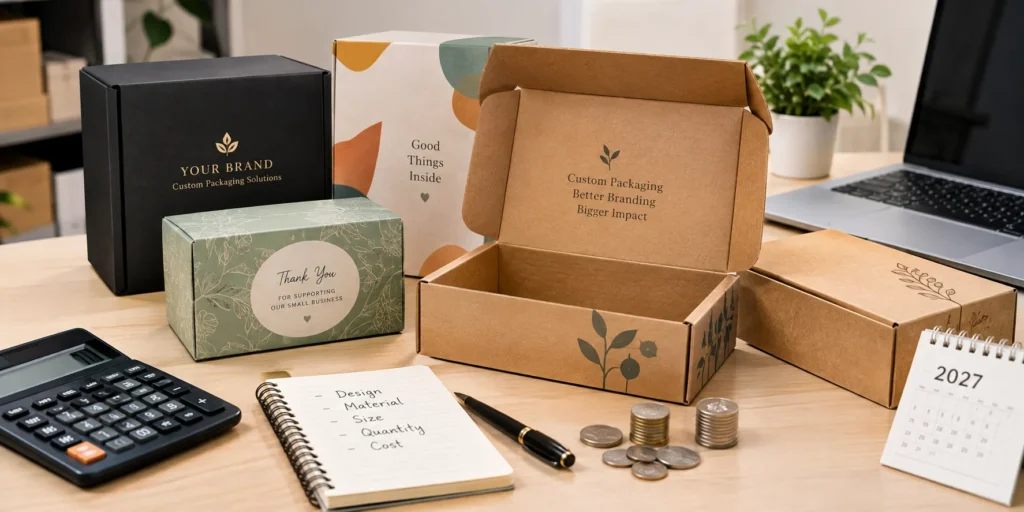
.jpg)