

On this page
Custom Packaging for Small Business: Quick Answers to the Questions Everyone Actually Asks
If you’ve searched Reddit for “custom packaging,” you already know the pattern: the same handful of questions get asked in r/small business, r/ecommerce, r/Entrepreneur, and r/Packaging over and over — MOQs are too high, suppliers lie about US locations, turnaround times balloon, and nobody wants to commit money before validating a product. This guide answers those exact questions in short, direct form.
Quick Answer: What’s the fastest way to get custom packaging as a small business?
Order from a supplier with a low minimum order quantity (100 units or fewer), US-based production, and free design proofing — this avoids the three most common complaints small sellers report: huge MOQs, hidden overseas sourcing, and slow, unpredictable shipping. Boxit Packages offers a 100-unit MOQ, 6–8 business day turnaround, free design support, and free shipping across the USA.
Do custom boxes require a huge minimum order?
Not necessarily. It depends heavily on the type of customization:
- Fully custom printed boxes (die-cut, full color): many factories still push 1,000–20,000 unit minimums, especially overseas.
- Digital printing / low-MOQ suppliers: minimums as low as 50–100 units are increasingly common and were specifically called out as a workaround in several small-business discussions.
- Sticker/label + stock box combo: effectively zero MOQ, but looks less premium and doesn’t scale branding well.
If you’re testing a product before committing to volume, look for a supplier that explicitly advertises a low MOQ rather than negotiating one down from a factory built for bulk orders.
When should a new brand invest in custom packaging — at launch or later?
The general consensus is: prove the product sells first, then invest in branded packaging. Common advice includes:
- Starting with a plain box, custom logo stickers, or stamped kraft paper.
- Moving to fully custom printed boxes once order volume is consistent.
- Reassessing packaging spend as margins improve, rather than front-loading cost before demand is proven.
That said, if your product is retail-facing (sold on a shelf, not just shipped direct), packaging matters immediately — shoppers judge unfamiliar brands on the box before they ever try the product.
How do I avoid custom packaging suppliers that lie about being US-based?
This is one of the most repeated frustrations: companies claim domestic manufacturing and US turnaround times, then ship from overseas with month-long delays. To vet a supplier:
- Ask directly for a manufacturing address, not just a mailing address.
- Check if the quoted turnaround (e.g., 6–8 days) is production time, shipping time, or both.
- Look for a real phone number that connects to a live team, not a call center that won’t transfer you.
- Read recent reviews specifically mentioning delivery accuracy, not just print quality.
What’s the actual cost difference between custom boxes and stock boxes with stickers?
- Stock box + custom sticker/stamp: cheapest option, works well under ~500 units/month, no design or die-cut tooling cost.
- Custom printed box (small run, digital print): moderate cost, no plates needed, ideal in the 100–1,000 unit range.
- Custom printed box (large run, offset/litho or flexography): lowest per-unit cost, but only pays off at higher volumes (often 5,000+ units) because of plate/tooling charges.
Rule of thumb from experienced sellers: full custom printing tends to become clearly cost-effective somewhere around the 1,000–10,000 unit mark, depending on box complexity.
Does custom packaging actually affect sales, or is it just nice to have?
Mixed but leaning toward “it depends on your product and price point”:
- For higher-priced or gift-oriented products, unboxing experience noticeably affects perceived value and repeat purchases.
- For everyday/utility products, plain functional packaging with a simple branded touch (tape, sticker, insert) performs just as well and avoids wasted spend.
- For retail shelf products, packaging is part of the purchase decision itself, not just an add-on after the sale.
The safest middle ground favored across small-business discussions: start simple (stock packaging + branding touch), then scale into full custom boxes once you know your margins support it.
What details do I need before requesting a packaging quote?
Suppliers consistently ask for the same core information, so have this ready:
- Product name and category
- Box dimensions (L x W x H, in inches or cm)
- Material preference (kraft, cardboard, corrugated, or rigid)
- Number of print colors
- Order quantity
- Logo/design file (PDF, PSD, or AI, typically under 20–30MB)
Having this ready before reaching out cuts several days off the quote-and-revision back-and-forth.
What’s a realistic turnaround time for custom packaging?
For low-to-mid volume orders from a supplier running domestic production, 6–8 business days after design approval is a realistic, commonly quoted turnaround — not counting the quote and design-proofing stage beforehand. Anything advertised as dramatically faster for fully custom printed boxes is worth double-checking before you commit.
Bottom line
Most of the frustration around custom packaging comes down to three things: MOQs that are too high for a new brand, suppliers that misrepresent their location or turnaround, and businesses investing in packaging before they’ve validated demand. Solve for those three, and the process is straightforward.
Boxit Packages addresses the first two directly: a 100-unit minimum, US-based operations, FSC-certified materials, free design support, and a stated 6–8 business day turnaround with free shipping. Get a free quote to see current pricing for your box size and quantity.
Need custom printed boxes?
Contact us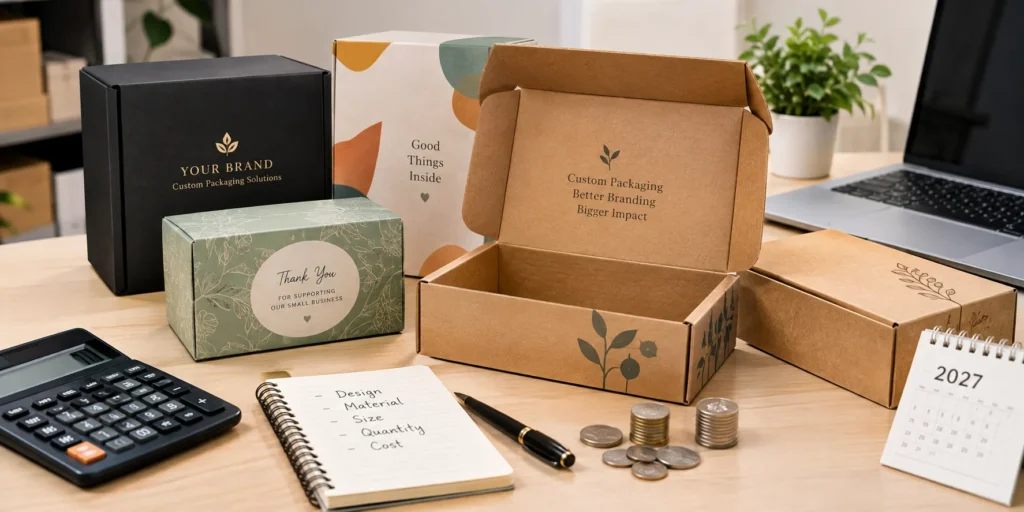
.jpg)